Start with the claim, not the legend
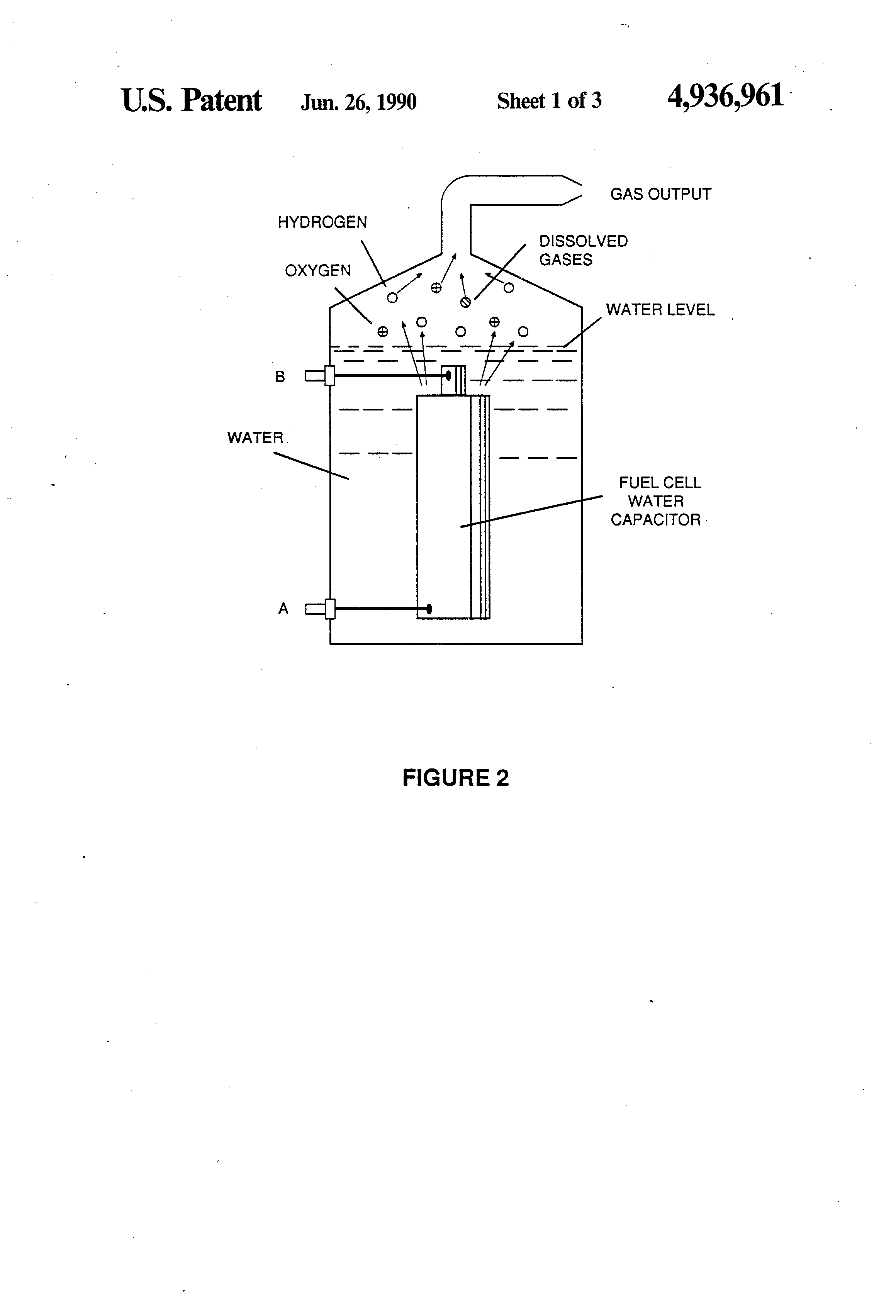
The water-buggy story associated with Stanley Meyer is often described as a vehicle running on water. The more specific document available here is US 4,936,961, published in 1990. It describes water in an electrical resonant circuit and claims production of a fuel-gas mixture containing hydrogen and oxygen. [1]
Meyer used “fuel cell” for his gas-producing assembly. That terminology can confuse readers: it is not the same function as a conventional hydrogen fuel cell that consumes hydrogen to produce electricity. Read the definition in the patent before comparing devices. [1]
A patent preserves what an inventor claimed. To establish useful performance, a separate experiment must show what the apparatus did, how it was measured, and whether another team reproduced the result. This article evaluates that evidentiary gap; it does not claim to have tested the buggy.
Can water be used to make fuel?
Yes. An electrolyzer uses electricity to separate water into hydrogen and oxygen. Hydrogen can then store and deliver energy. The relevant source is the energy used to produce it, not the water by itself. [2][3]
Some high-temperature processes use external heat to reduce their electricity requirement. That heat belongs inside the energy accounting. Reporting only electricity while omitting supplied heat would make an incomplete comparison. [2]
“It produces gas” and “it produces more usable energy than it consumes” are therefore different claims. Bubble volume is not enough: a gas measurement needs composition, temperature, pressure, water-vapor correction, and a stated energy basis.
Why an alternator loop does not close itself
- ElectricityExternal supply
- ElectrolyzerHydrogen production
- EngineMechanical output
- AlternatorElectrical output
Consider a deliberately simplified numerical example: 1 kWh enters an electrolyzer, 70% becomes chemical energy, an engine converts 30% of that into shaft work, and an alternator converts 80% of that into electricity. The returned energy is 1 × 0.70 × 0.30 × 0.80 = 0.168 kWh.
The shortfall is 0.832 kWh before other loads. These percentages are illustrative assumptions, not measured values for Meyer or specifications for equipment. The example shows why multiplying conversion stages does not create energy. Any proposed extra source must be identified and measured.
Resonance can change voltages, currents, and the timing of stored-energy exchange. It does not remove the need to integrate real power over time. Multiplying a peak voltage by a separately observed peak current can give a misleading result when the waveforms do not align.
What would a defensible test record contain?
| Boundary | Record | Common gap |
|---|---|---|
| Electrical inputs | Time-aligned voltage/current; controllers and auxiliary supplies | Ignoring pulse shape or a separate power rail |
| Stored energy | Battery and capacitor state before and after the run | A short demonstration drawing down storage |
| Material inputs | Water, additives, electrode mass, and all other fuels | A consumed chemical or metal acting as fuel |
| Gas output | Composition and corrected quantity over time | Counting vapor or air as hydrogen |
| Useful output | Calibrated shaft work or electrical load energy | Motion without a quantified load |
| Repetition | Raw data, uncertainties, controls, independent repeat | A video with no inspectable measurements |
A run should last long enough to expose changes in storage and materials. A favorable result should survive instrument cross-checks and a repeat with the same declared boundary. The recording template is a starting point, not a certification procedure.
Hydrogen/oxygen mixtures, ignition sources, pressure, and high voltage create serious hazards. Do not collect mixed gas, modify a vehicle fuel system, or treat this audit as a construction procedure. Testing belongs with qualified personnel and appropriate equipment.
What about the court case and death stories?
This source set does not include an authenticated court judgment, coroner record, or complete independent vehicle-test dataset. We therefore do not publish a legal quotation or cause-of-death conclusion here, and do not present poisoning allegations as established fact.
The absence of those documents in this article is not proof that no records exist. It is a limit on what this audit can responsibly conclude. Neither a dramatic biography nor an accusation settles an energy measurement.
What is worth pursuing instead?
Document externally powered hydrogen production as storage or industrial fuel, and compare its full-system requirements with direct use of electricity. For practical household options, begin with the Energy Cost Lab. A technology can be interesting without being self-running.
Sources and reading limits
These references support the specific claims marked above. A publication, patent, demonstration, and independently replicated result are different kinds of evidence.
- Stanley A. Meyer: US 4,936,961, Method for the production of a fuel gas
Primary record of the inventor's proposed resonant method and terminology. Not independent validation of vehicle operation or excess energy.
- DOE: Hydrogen production through electrolysis
Explains electrical water splitting and how externally supplied heat can change the electrical requirement. Not a test of Meyer's device.
- DOE: Hydrogen fuel basics
Distinguishes hydrogen as an energy carrier from the resources used to produce it.
For classification and correction standards, read how we evaluate evidence.